Showing posts with label New Orleans. Show all posts

Friday, July 20, 2018

The Legend of the Grunches

New Orleans has scads of legends, many from the 18th and 19th centuries which you can pursue if you have an interest. 

One of very recent origin (probably) is the story of the Grunches.

According to local legends, there is a race of misshapen albino dwarves (or lizard-like creatures) who prey on goats and dogs and sometimes humans. Their supposed hangout is in East New Orleans in the Little Woods area. Reports of seeing them come from time to time; often from teens who elected to park off a shell road for necking or serious fooling around and seeing a goat tethered or being eaten by one of these. The story is, if you see a tied-up goat, then get outa there pronto!

Supposedly these were creatures that were frightening enough that people tended to shy from them; and they became increasingly reclusive and dangerous with time.

After Hurricane Katrina and people began to move back into Lakeview and Gentilly (two New Orleans neighborhoods close by Lake Ponchartrain), stories began to circulate that you should not leave pet dogs or cats outdoors at night lest they be carried off by one of the Grunches. Probably those pets merely took French leave. Pets tend to do that sometimes. And there's always possible malevolent neighbors. No Grunches need apply as those who carry away pets.

These stories are like the spooky stories told elsewhere about the homicidal maniac with a hook on one of his arms. Anyway, the warning stands: Don't park along Grunch Road.

Gannon Road in Little Woods is the locale often referred to as Grunch Road, in case you're interested. Personally, I'd stay away due anyway to the often dangerous members of homo sapiens that to be around in that section of the city.


Grunch?


Tuesday, October 25, 2016

A Flourish of Strumpets

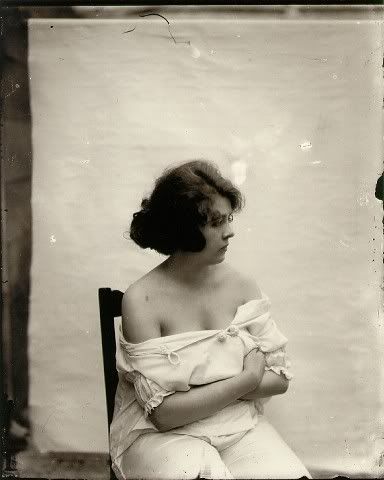
New Orleans photographer Ernest J. Bellocq did a series of photographs of prostitutes in Storyville, the famed red light district in New Orleans.

He was known retrospectively as an eccentric; not a mean feat in New Orleans where eccentricity flourishes like St, Augustine grass and hibiscus. Ernest Bellocq was known as a commercial photographer in his lifetime.  It was only in the 1950s that his secret avocation of portrait photography of the prostitutes of Storyville was discovered by Lee Friedlander.

Storyville was the notorious red-light district in the Tremé faubourg. It was so-named after Alderman Sidney Story, who proposed the ordinance limiting prostitution into this district. Alderman Story was not pleased at the name popularly given this district. That's a shame; most citizens know the names of few of the former mayors and city commissioners but his is remembered.

The district itself had both elaborate parlor houses and flimsy shacks (called cribs). The newly-emerging music form called jazz developed here. It became a haven for all sorts of unsavoriness: it became a tourist attraction.

The harlots accepted Bellocq, and several allowed him to document them and their lives with portraits and candid shots. Here are some examples of Bellocq's work. I have left out nudes, but they can easily be found with a Google search (NSFW). I have a sense that the photographer and the prostitutes were sympathetic with each other, and he respected their dignity.

Storyville was closed down by the Navy Department in 1917.

Unfortunately, E. J. Bellocq was not served well in either books nor movies that used him as a character. Louis Malle's Pretty Baby was especially notorious.  Malle's disgusting film (in my opinion) slandered this fine photographer, as well as had a then-twelve-year-old child appear in a nude scene. Don't waste your time with such cinematic dreck.

 http://www.huffingtonpost.com/2013/03/26/ej-bellocq-vintage-photos-from-new-orleans-storyville_n_2948713.html


Monday, July 18, 2016

Free Range Children

I guess it's a universal fact of society that people and groups have their own views about how to rear children as well as the long-standing opinions on politics and how many cats should a person be allowed to keep. Anyway, it seems that the presently common parental styles of attachment parenting and helicopter parenting have a subversive opposite: the concept of free range children.

Basically, the term "free range children refers to children who are allowed to roam around the neighborhood or even town without immediate supervision. The desirability of this concept seems to be founded in books like Mark Twain's Tom Sawyer and Huckleberry Finn. To be sure, nineteenth-century river towns probably had fewer perils than large cities do today. Also, there was less widespread awareness of those possible threats. Some parents told their children to beware of the boogerman (or bogeyman). Was this term a euphemism for a child molester or killer?


Some proponents of free-range parenting occasionally elicit visits from Child Protective Services because others see her or his style to be neglectful of their children. One set of parents got called out because they allowed their eight year old daughter go on the subway unaccompanied. In response, the free-range children parenting advocates have organized free-range play groups, free-range playgrounds, and free-range Sunday School classes.

Organized free-range groups: is that an oxymoron?

Anyway, I was told when I was young that I could ride my bike anywhere in Lakeview (in big, bad New Orleans) up to the railroad underpass and Larry's Homedale Inn. Alas, Tad Gormley Stadium was not in that area, but the Mardi Gras Fountain, Harrison Avenue, and Rockery Inn were. We once put detergent in the fountain!  I made it into adulthood.

Needless to say, the French Quarter and the Central Business District were far away.

The point is, peoples' ideas about proper parenting change, sometimes this is related to the real-life situations that children have to be in. Parents should understand the child's neighborhood. And so should nosy bystanders.


Wednesday, December 23, 2015

Less Noted Statues of New Orleans

Recently some efforts by some people, including the douchy Mayor, to remove some Confederate-themed statues has made some wire services. I will express openly my wish to provide continuing General P. G. T. Beauredard in place, since he was one of us (I still think of myself as an Orleanian, having experienced Katrina and more of my life having lived there.)

I also point out that iconoclasm can be a trend that can go into some other territory. Consider this Brit- and Indian-killer from the old days:


Will Old Hickory get banished to the museum or city dump? You can bet that doing that would displease a lot of folks.

But, anyway, here's a collection of some other, probably noncontroversial statues in New Orleans:

Louis Armstrong, Old Satchmo himself, in Louis Armstrong Park! Everybody loved him.


Fats Domino, Al Hirt, and Pete Fountain. We can take a closer walk with them:


There's one of Chris Owens, a former burlesque entertainer from the French Quarter:


It would not be New Orleans without some suitable monument honoring the New Orleans Saints, Superbowl Champions in 2010 (Hooray!):


This charming statue graces a garden:

Saint Jeanne d'Arc is resplendent in gold:


And Winston Churchill is giving a peace sign:


Civic benefactor Margaret Haughery, who spent her time ceaselessly helping the poor, certainly deserves a statue as well as a celestial crown:


John McDonough gave his fortune to benefit New Orleans schools, has been honored with a statue and several public schools named after him:


Why not have a statue of Ignatius J. Reilly, fictional character in John Kenneth Toole's A Confederacy of Dunces?  Dunces enough rate statues in most cities.


Semper Fi! Molly Marine, the only statue honoring the Women's Marines from World War II:


Bienville founded New Orleans in 1718. Surely he rates a statue:


And so does Bernardo de Galvez, Spanish military figure who conquered Pensacola during the American Revolution.


Simon Bolivar, South American liberator, rated a statue:


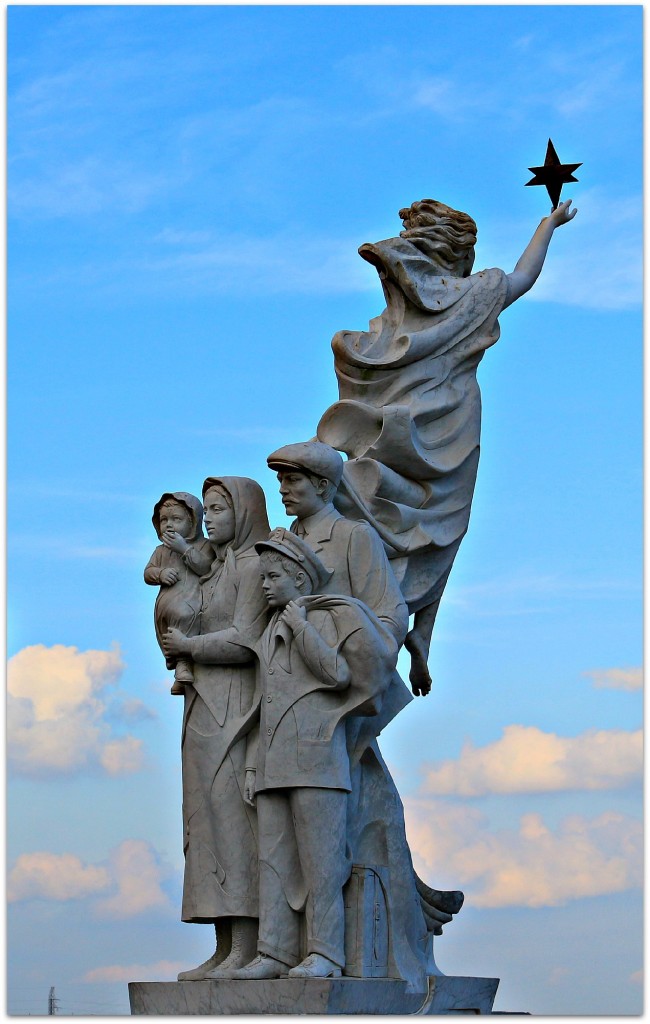
And there's even a statue honoring New Orleans's immigrants:


Artful funerary statues from some old New Orleans cemeteries that have a timeless grace and pathos:


Wednesday, June 10, 2015

The Special Occasion for a Girls' Night Out

It was the usual Yat* Sisters' night out; but Jane made a reservation at their hangout for dinner for the amazing six. Sometimes it's a good idea if you have a large group and want a table for a festive dinner. (Jane was a little obsessive-compulsive; she got nervous if things were left up to chance.)

Anyway, apparently the hostess was cheerful and accommodating as a good hostess should; and she asked if it was a special occasion. Jane rather flippantly answered, "Oh, we're celebrating Megan's loss of virginity." And thought no more about it, since she thought that the hostess, who knew them, was aware that she was kidding.

Came the girls' night out. They were seated at a really good table for six, and the waiter brought a nice wine. Hey, the service got ramped up since last time it seemed! And the guitarist came and performed a soulful song for Megan and gave her a single, long-stemmed rose. All of us, Jane included, were confused.

Finally, Jane figured it out: the restaurant hostess took her remark literally, and they were really celebrating Megan's loss of virginity! 

After dinner, while the girls were having some coffee before going to a club, the waitress brought out a cake made in the form of a woman's torso to mark the festive occasion. Jane was embarrassed at thing turn of things; and never got up the nerve to tell Megan or the others why those special attentions were provided! 

Did it stop Jane from making offhand, flippant comments in the future? No, making flip remarks is a habit that's hard to break even when you occasionally get hoisted by your own petard. During the next girls' night out, Megan remarked that she enjoyed the celebration of her loss of virginity. It was more fun than when it originally occurred ten years before!

Megan earned some valuable good sport points; always a good deal when the Yat Sisters are hanging out together!

*A New Orleans native; from the greeting, "Where y'at?"


Celebratory cake for the occasion.

Monday, June 1, 2015

Tchoupitoulas Street

One of the more curious names of New Orleans streets is Tchoupitoulas Street, located in the Central Business District. It was named after a Native American tribe, and it is hard to pronounce.

It was back in the horse and buggy days, and one of New Orleans' finest was walking his beat in the Business Section (the old American section) when he saw a dead horse curbside on Tchoupitoulas Street. Immediately he pulled out his notepad and tried to write that fact on it. Unfortunately, the task was hard because some kids stole the nearby street signs.

He started: 'C-H-A-P-A-T-W-O'....but sensed that it was wrong. 

So he tried again: 'C-H-O-P-I-T-O-O-L-I-T-Z.' But that didn't look right, either.

So, one more time: "C-H-A-P-I-T-O-O-L-E-T'S.' But that didn't look right also.

Finally, he just thought, "To hell with it." And dragged the dead horse up a block to Camp Street.

[Tchoupitoulas is pronounced roughly "Chop-a-too-lus."]

An old street sign:

A newer version:


Monday, December 15, 2014

Langiappe

To give lagniappe (pronunced lan-yap) is an old custom of the New Orleans area.  It involves a merchant or tradesperson giving a customer more than the bare aspects of the deal.  For example, a grocer may throw in a bunch of parsley or cilantro or some gum, a bartender may have a plate of goodies for the customers to taste, a baker may put in an extra doughnut in a dozen, or a druggist may have an art calendar suitable for hanging.

I think it's a gentle form of cultivating social capital by attempting to give the customer the sense that he's appreciated.  Doing business is not only for the money, but is also for the relationships.  Part of doing lagniappe is in the conversational exchange.  While this takes time, and some impatient people might find this a bit much, it does serve a purpose in providing some loners with a level of contact that is within their comfort zone.


I hope lagniappe will persist as a social grace in the future. 


Thursday, November 7, 2013

The Television Personality and the Cabbie

What a story for Al Gautreaux and Missy Chauvin to cover on Action News!

This was a local saga of a lawyer/television personality and a local cabbie.  I leave it to you to sort it out, and figure what was going on.

First, the taxi driver picked up a young female on Bourbon street who apparently had a few drinks and was flirtatious with him.  This was a local radio celebrity who was also an attorney.  She later filed a police report that the taxi driver took an upskirt picture of her, and then tried to extort some money to destroy the video.  The claim was that he first asked for $60,000, but modified it to $1,000!  Apparently, that was the local going rate for upskirt videos of attorneys in New Orleans.  The recession does that to extortion, apparently.

Recently, Mike posted a video that addressed a similar matter.

The N.O.P.D. dutifully arrested him and sent him to jail.  Orleans Parish Prison is a nasty place.

This story made a row, even by New Orleans standards, and was even picked up by a newspaper in Britain, that seat of probity in reporting.

Later on, the case against the cabbie was dismissed; still leaving him with numerous debts incurred because of his incarceration.  And the N.O.P.D. soon had occasion to file false arrest charges against the attorney!  This must have made their day, given the somewhat adverserial relationship between the minions of the law and some officers of the court!  If convicted, she could get a year in jail, herself.

Al:  "Anything more on the taxi driver and the radio personality, Missy."

Missy:  "Only this, Al.  The Police Department has filed charges against her based on the possibility that she fabricated the story leading to the driver's arrest."

Al:  "Is there any chance we can get an upskirt photo of someone to run on the 10 P.M. news?"

Missy:  "That would be a ratings boost; but not likely to be approved by the F.C.C."

Al:  "Oh well, bare bottoms are not unheard of on Bourbon Street."

Missy:  "Maybe we could have the participants come on like on the old Jerry Springer Show?"

Sometimes real life outstrips imagination in New Orleans.  At least Nancy Grace was not involved.  As the Prophetess would have observed, that was the most graceful thing of the whole sorry, ambiguous affair.


Monday, August 5, 2013

General Benjamin Butler

After New Orleans fell in 1862 to the Yankees, it underwent a period of occupation by Union troops.  They acted about like you would expect tourists with guns to act, even to the point of petty thievery.  Their commanding officer, one General Benjamin F. Butler, was particularly noxious to the inhabitants, especially the ladies of New Orleans.  However, all soon was forgiven; they honored General Butler in a special way with his commemorative chamber pot. that soon became very popular.

General Butler established a veritable turdocracy there.  [Thanks for the expression, Elvis.]  He also known for stealing spoons, hence his nickname "Spoons" Butler.

He came from Boston, where he was a politician before soldiering.

Butler made a big ass of himself; and he was replaced by Gen. Nathaniel Banks.  He was better at p.r. as head of an occupying force.  As a matter of fact, they later named after him a pretty street with a tree-lined neutral ground and nice homes on it.


Monday, March 25, 2013

Benjamin Buisson and New Orleans Street Names

Pierre Benjamin Buisson (1792-1874) was a French soldier, later New Orleans newspaper editor, parish surveyor, and (much later) even a Confederate brigadier general.  He had a fascinating life, as this brief bio summarizes.

While he was a Lieutenant in Napoleon's army, he was given a battlefield promotion for valor by the Emperor himself.

After the restoration of the Bourbons, he, like several other former French officers, migrated to the New World; in his case, to New Orleans.  He gained employ variously as an architect, surveyor, and even edited a French language newspaper.  Being in New Orleans, he also managed to fight a few duels.

One of his contributions was the establishment of an artillery unit in the local militia.  He wrote a handbook on tactics for light artillery.

Anyway, while surveying Uptown New Orleans, for the Faubourg Bouligny neighborhood, he chose the names of the streets, all on a Napoleonic theme.  Napoleon Avenue was the major thoroughfare; and there was a Josephine Street.  Several streets were named after Napoleon's victories, such as Berlin, Cadiz, Austerlitz, Marengo, Jena, and others.  After all, Napoleon awarded him the Legion of Honor.  Semi-ironically, these streets were in the American district!

During World War I, Berlin Street was re-named General Pershing.  This was a bit of misapplied patriotism, since the street was named after the Napoleonic victory and not the city.

A legend has it that his grandchildren used to tease him as to why there was an absence of Waterloo Street.  It reliably pissed the old man off!

Pierre Benjamin Buisson


Monday, August 13, 2012

How to Dress Like You're Easy in The Big Easy

This summary is not available. Please click here to view the post.

Tuesday, December 27, 2011

Don Esteban Rodriguez Miró

Sometimes governmental officials and politicians do the right thing; and we should wonder at those moments of grace amid the usual weeds of corruption,  A truly shining example occurred in Louisiana in the 1790's with Don Esteban Rodriguez Miró.

In Louisianan Miró is chiefly remembered for two reasons: his speedy and effective rebuilding of the city after the disasterous fire of 1788, and for having prevented the establishment of the Spanish Inquisition in the territory.  This last act was an act of high courage, without a doubt.

The story as written by 19th century Louisiana historian Charles Gayarré:

"The reverend Capuchin, Antonio de Sedella, who had lately arrived in the province, wrote to the Governor to inform him that he, the holy father, had been appointed Commissary of the Inquisition; that in a letter of the 5th of December last, from the proper authority, this intelligence had been communicated to him, and that he had been requested to discharge his functions with the most exact fidelity and zeal, and in conformity with the royal will. Wherefore, after having made his investigations with the utmost secrecy and precaution, he notified Mirò that, in order to carry, as he was commanded, his instructions into perfect execution in all their parts, he might soon, at some late hour of the night, deem it necessary to require some guards to assist him in his operations.

Not many hours had elapsed since the reception of this communication by the Governor, when night came, and the representative of the Holy Inquisition was quietly reposing in bed, when he was roused from his sleep by a heavy knocking. He started up, and, opening his door, saw standing before him an officer and a file of grenadiers. Thinking that they had come to obey his commands, in consequence of his letter to the Governor, he said: 'My friends, I thank you and his Excellency for the readiness of this compliance with my request. But I have now no use for your services, and you shall be warned in time when you are wanted. Retire then, with the blessing of God.' Great was the stupefaction of the Friar when he was told that he was under arrest. 'What!' exclaimed he, 'will you dare lay your hands on a Commissary of the Holy Inquisition?' — 'I dare obey orders,' replied the undaunted officer, and the Reverend Father Antonio de Sedella was instantly carried on board of a vessel, which sailed the next day for Cadiz."

So much for Gayarré's purple prose.

As a little background, Louisiana was ceded to Spain by France in 1767.  The Louisianans had a brief revolution, which was crushed with a few hangings, and the new Spanish colony drifted off into the usual corruption.  In the 1790's fearing some New World manifestation of the French Revolution, the Crown sent the Inquisition in place.  Fray Antonio Sedella was, in effect, its enforcer.  He was granted extraordinary powers to root out all manner of unorthodoxy, including perhaps the use of torture! 

Governor Miró saw this as a bad thing that would depopulate the colony, so he kicked the good padre out!  Hasta la vista, Padre!  Miró's policy, approved by the Crown, had originally been to strengthen Spain's hold on Louisiana against the newly emergent United States and other powers by encouraging settlement; in doing this, he developed a practice of compromise: requiring the public practice of Catholicism, but ignoring private worship.  Louisianans at that time were Catholic predominantly, but relatively loose and nonorthodox in their practice.  This attitude towards religion there still persists today.

It is important to remember that the Spanish Inquisition had considerable teeth even in the 18th century: it could ruthlessly punish its enemies.  It was not beyond possibility that a governor of a minor colony could himself be the major offering in an auto-de-fé!

So remember Steve Miró and his grandes cojones de acero!  He  rose up to be a courageous leader when it was most important: he thwarted the only attempt to establish the Inquisition in what became eventually the United States.  Louisianans have cause for gratitude.

Thursday, August 12, 2010

A Glossary of New Orleans Expressions

One of the drawbacks of living in one community all of one's life is that the listener comes to view the language that is heard on a daily basis is nationally normative. Alas, that is not the case, as I found when I left New Orleans and casually referred to a cur as a "cayoodle." People looked at me like I was demented. However I have collected some terms and phrases peculiar to New Orleans. Here's some expressions from my area (Orleans, Jefferson, and St. Bernard Parishes):

[The] Ain'ts -- the New Orleans Saints
Alligator pear -- an avocado
Awrite -- all right
Banquette (pronounced ban/ket) -- a sidewalk
Batture -- the strip of land between a levee and the river
Bobo -- a small cut or injury
Bourré – a French card game (pronounced BOO-ray)
Brake tag -- vehicle registration sticker
Cagoo (or possibly cagu) -- sick
Cap, Cap'n -- general form of familiar address to adult men
[The] Channel -- the Irish Channel, up around St. Alphonsus and Redemptorist High
Courage – energy, pep. Probably from élan.
Cayoodle -- a mongrel dog
Charmer – a sarcastic reference to a girl or woman
Dawlin' -- a familiar form of address: women call both men and women 'dawlin'; men call women 'dawlin.'
Don't have any courage -- lack energy or pep
Do-do (doh-doh) -- sleep
Fais do-do -- a street dance, but primarily in Cajun country.
Faubourg – neighborhood
Fixin’ to – about to
Flying horses -- merry-go-round
Fo' true -- really
Four bits -- fifty cents
Gallery -- porch
Go-cup -- a paper or plastic container to carry alcoholic beverages off the premises
Go by Mama's -- visit one's mother
Go to the submarine races -- go park along the Lakefront and make out
Grillards -- broiled veal in gravy
Grip -- a small suitcase
Grippe -- the flu
Gris-gris -- a powdered substance having magical properties
Ice box -- a refrigerator
Laissez les bon temps rouler -- let the good times roll
Lagniappe -- something extra thrown in by a store as a gift to customers
Make groceries -- get groceries
Make do-do -- go to sleep
Maw-maw -- grandmother
Minette, Minou -- a pussy cat
Mudbugs -- crawfish
Neutral ground -- the grassy median of a boulevard
Panné meat -- breaded cutlet
Pass the vacuum -- vacuum
Passez (Pos/say) -- a game in which someone takes some belonging from someone and passes it around from person to person, keeping it from the owner
Paw-paw – grandfather
Picyaune – small, nit-picking
Po-boy -- a sandwich using part of or the entire French bread loaf
Podna -- a familiar form of address by one man to another
Police jury -- a governing body of a subdivision of a parish
Professor -- a piano player
Roll -- rob by means of force
Shoo-shoo -- used either to refer to an abject failure, or specifically to refer to a firecracker that doesn't go off
Shoot da shoot -- a playground slide
Shotgun house -- a long, narrow house in which each room has a door that opens to the one which follows.
Sit before the door -- sit on the porch
Six bits -- seventy-five cents
Snowball - snow cone
Streetcar -- a trolley
[The] West Bank -- on the other side of the river: Gretna, Algiers, Harvey, Marrero, Westwego
Two bits -- twenty-five cents
Where ya'at -- Standard New Orleans greeting
Yat -- New Orleans native
Zink -- sink


The origins of some of these have to be speculative.  After all, New Orleans is a seaport and had been enriched culturally and linguistically by people originating from many different places.  In that way, the cayoodle is really the native and prototypical dog of New Orleans.  Furthermore, the use of these expressions tends to be neighborhood-specific.  Heavy use in Mid-city or the Ninth Ward, a moderate amount in Lakeview or Gentilly, almost none in the Uptown area or Garden District.